Choosing a CRM in the AI Era: Established Platform, AI-Native CRM, or Build Your Own?
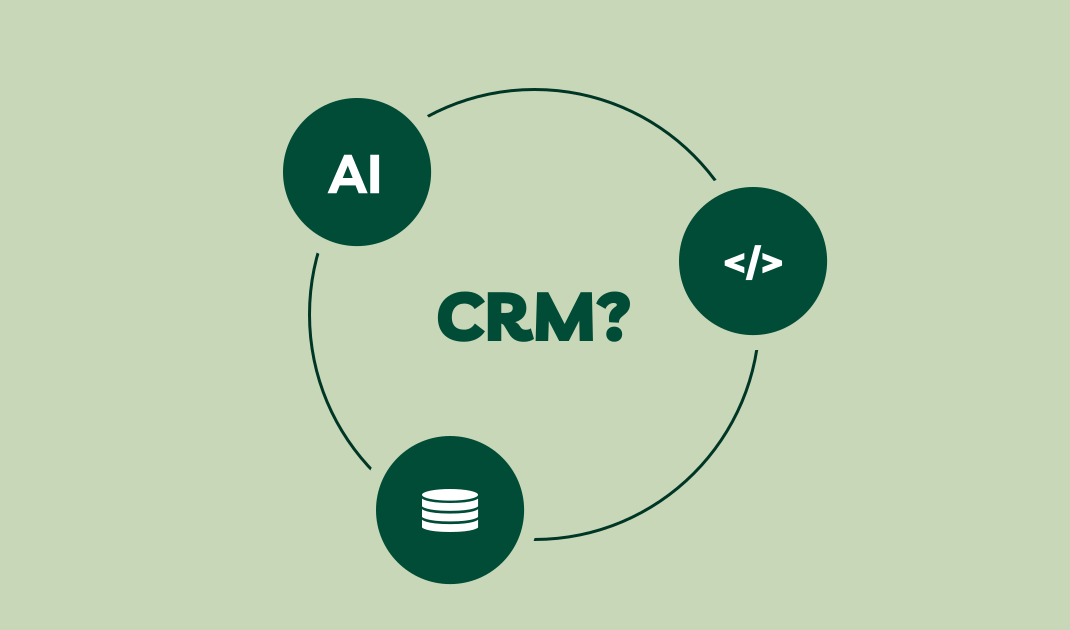
A few years ago, choosing a CRM mostly meant comparing vendors. Today, you're facing three very different paths: an established platform, an AI-native CRM, or a system you build yourself with AI. I've worked in B2B sales since 2010, and in this article I'll walk through all three, including the areas where I'm not sure myself. I'll also show you which questions to answer before you decide.
Key takeaways:
If you're choosing a CRM today, you have three basic options: an established platform (Salesforce, Microsoft Dynamics, SAP, or HubSpot), an AI-native CRM like Attio, or a system you build yourself. There is no single right CRM for everyone. What matters is the kind of company you are and where you interact with customers, how much you want the CRM to do, and whether customer service is part of the picture. In the end, whether a CRM rollout succeeds depends mainly on whether your people can get their customer conversations into the CRM easily and completely.
Which CRM is right for us?
I've worked in B2B sales since 2010, and over that time I've gotten to know a lot of CRM systems: HubSpot, Pipedrive, Salesforce, Microsoft Dynamics, SugarCRM, SAP. For a long time, deciding which CRM to implement was a lot of work, but it was manageable. You compared vendors, made a choice, and then worked with it for years.
That's no longer the case. I'm facing this question myself, and I can tell how hard it has become. I work with companies that are in the middle of rolling out a CRM, and with a young startup that simply built its own CRM with AI. Watching all this, I'm honestly torn: on one hand excited and curious to see how well it works, on the other a little worried.
One thing up front: choosing a CRM is complex, and you won't settle it with a handful of questions. Depending on what stage a company is at, many other factors come into play, and some industries have specialized solutions built just for them. But there's one thing I'm firmly convinced of: the way we use CRM is fundamentally changing. A few years ago, it was perfectly normal to log in, click through screens, and edit data there. That's exactly what users want to do less and less today, and any selection process should take that into account.
This article won't give you a ready-made answer. There is no one right CRM, and there never was. But I hope it helps you ask the right questions before you decide.
Why is choosing a CRM so difficult today?
The great strength of established CRM systems has always been their ecosystem. You could connect them with all kinds of other solutions and extend the system on a common standard. That matters, because software doesn't stand still. If you bet on a standard, you can grow with it.
At the same time, I see a trend that calls this advantage into question: nobody really wants to work only in user interfaces anymore. Even a Salesforce interface today isn't something people enjoy clicking through, completing step after step by hand.
Vendors have recognized this and are responding in very different ways:
- Salesforce is buying. This year alone, Salesforce has acquired Contentful, Fin (formerly Intercom), Listen Labs, and Braze, among others. The Braze deal was worth around $5.66 billion. In early November, it added Cresta, a provider of voice agents. All of this feeds into Agentforce, the platform for AI agents that work directly with CRM data.
- Microsoft is making the CRM disappear. In October, Microsoft announced 30 new Copilot skills for Dynamics 365. The idea: you no longer open Dynamics at all, but get briefings, updates, and alerts directly in Teams and Outlook.
- SAP is betting on agents in version 2. In Sales Cloud and Service Cloud V2, several Joule agents are slated to become generally available by November 2026, for example for deal qualification and case management.
- New vendors call themselves AI-native. Attio, for example, raised a $52 million Series B in 2025 and, according to spending data from Ramp, is currently the fastest-growing CRM vendor.
- And some simply build their own. With tools like Claude Code, Cursor, or Lovable, you can now build a working CRM in a matter of days.
So choosing a CRM today is no longer just a choice between vendors, but between three fundamentally different paths. Before we get to them, though, it's worth taking a hard look at your own company.
What questions should I answer before choosing a CRM?
The following three questions are no substitute for a full selection process. But they're a good starting point before you compare vendors.
1. What kind of company are you, and where do you interact with your customers?
At first, I looked at this question too much through a software lens myself. A woodworking manufacturer has very different customer touchpoints than a software company: phone, field sales, on-site appointments. Think about which parts of your business deal with customers and where information needs to be documented. Some industries and channels have their own dedicated solutions.
2. How far should your CRM go?
Should it mainly store contact data and give sales an overview? Or do you also want to use it for marketing automation and campaign planning? The scope determines which systems are even an option.
3. Is customer service part of it?
If your support team also works in the CRM, you get the much-cited 360-degree view: one central place that holds every piece of information about a customer. But that only works if the data is good and well maintained.
With these answers in mind, let's look at the three paths.
When is an established platform like Salesforce, Dynamics, SAP, or HubSpot the right fit?
Salesforce, Microsoft Dynamics, SAP, and HubSpot are the names that come up in almost every selection process. Everyone knows their strengths: a large ecosystem, lots of integrations, partners who help with implementation, and the reassurance that the system will still be around in five years.
At snapAddy, we use HubSpot ourselves. The reason is simple: we come from the software and SaaS world, where HubSpot is very common. That alone shows how much your own background shapes your choice. A company from a different industry often ends up somewhere else entirely.
I'm deliberately not going to say which platform is the right one. Salesforce's acquisitions bring some exciting building blocks to the table. At the same time, you're less tied to a single vendor than you used to be: you can still use Slack, for example, even if you choose Dynamics. And nobody can say for sure today whether Microsoft's approach, where the CRM gradually merges into Teams and Outlook, is the right one.
What I can say for sure: no company works with just one system. The CRM has to talk to ERP, marketing tools, support, and many other solutions. That's exactly why every company has to make this decision for itself.
What do AI-native CRMs like Attio offer?
Vendors like Attio set out to build a CRM from the ground up for the AI era, rather than bolting AI on later or buying it in.
I took a look at Attio a few months ago. My impression: fine, but nothing special. Fields are fairly easy to set up with a few clicks, but the interface didn't win me over.
Then I asked myself: does it even need to? If a CRM is truly AI-first, maybe completely different things matter. How good are the APIs? How open is the ecosystem? Is there an MCP server that lets AI agents access the data directly?
What I actually expected from an AI-first CRM is a different way of working with the system. I want to chat with my CRM, or simply talk to it, instead of filling out forms. The way data gets entered has to change, not just the design. That's the standard AI-native vendors should be held to, and it's the standard you should hold them to when you choose.
Is it worth building your own CRM?
Probably the most talked-about topic of 2026 has been the vibe-coded CRM. The examples sound impressive. Over the summer, the CEO of Curative said his company had canceled its Salesforce contract, worth around $600,000 a year, because its own CRM, built in two months, was good enough. The Wall Street Journal has also reported on small and midsize companies taking this route.
What excites me about it: I've always felt a bit trapped in CRM systems. You work within their structures and can only break out to a certain extent. But many companies are highly individual, and some processes are hard to map in a standard system. A self-built CRM fits exactly what you do.
But that raises an uncomfortable counter-question: should a company even have processes that deviate so far from the standard? Maybe the process doesn't fit into the CRM because it simply isn't a good process.
What worries me:
- Migrating later. If a company grows and eventually wants to switch to a standard CRM after all, that can get very expensive. Maybe that fear is unfounded, because AI will handle mapping data and processes in the future. I'm not sure about that.
- Scaling. Will a self-built CRM hold up when it's not five but 50, 100, or 500 salespeople working in it?
- One-off customizations. The more you bolt on, the greater the risk that the system eventually becomes slow, unusable, or insecure.
So who is it worth it for? Honestly, I can't give a definitive answer. For a company that wants to grow quickly and hire a lot of people, I'd tend to advise against it, because the pain of switching later can be considerable. A small company that deliberately stays small and lean, and has the time and know-how, can certainly give it a try.
The key question is: does the speed I gain at the start give me more than it costs me to work around standards? Or will I get lost in constantly developing my CRM instead of putting that time into my actual business?
At snapAddy, we made a clear decision early on not to build our own internal software, but to buy SaaS solutions so we could get up and running quickly. Whether I'd make the same decision today, I don't know. Software can now be developed much faster than it could ten years ago.
Why does data determine whether a CRM rollout succeeds?
Whichever path you choose, one thing stays the same. The fewer people click through interfaces and the more AI agents work on their own, the more data quality matters. An agent working with outdated or incomplete contacts can quickly make the wrong decisions, and nobody notices in time.
You choose the system once. Whether your salespeople actually use it is decided all over again with every single customer interaction. If someone has to type twenty conversations into the CRM by hand after a long day at a trade show, sooner or later they'll stop doing it. The information then stays on business cards, in notebooks, or in people's heads. That's why, for me, the most important question after the selection is: how do I make data entry as easy as possible for my people?
Data quality is still a real pain point for many companies. We see it at snapAddy every day: companies come to us specifically because they want to improve their data quality or because they want to capture qualified leads at trade shows and follow up on them.
Precisely because AI is taking over more and more routine work, meeting in person is becoming more important. The time you actually spend face to face with a customer, at a trade show, at an event, or on site, is the most valuable thing sales has. That makes it all the more important to fully document these conversations afterward and get them into the CRM. Only then can the whole team keep working with that data, and only then can AI agents build on it in a meaningful way.
There are different ways to do this. Besides voice notes after customer meetings or automatically pulling data from email and calendars, there are specialized solutions. At snapAddy, we've focused on exactly this: contacts are captured right at the booth, conversation notes are simply dictated, and the data lands in the CRM without anyone having to catch up in the evening. We provide the right apps and technology, including for large teams with hundreds of users across many events. And we help calculate the return on investment, answering the question every sales and marketing leader asks: what are my events actually delivering?
When data entry becomes easy, adoption goes up. And only a CRM that people actually use has an impact on revenue: leads get followed up faster, fewer opportunities slip through the cracks, and everyone on the team knows who talked to whom, when, and about what.
How we'll use CRM going forward
CRM interfaces will become more and more interchangeable. Some companies will build their own, others will get them in Teams or through voice. The foundation underneath, meaning complete, up-to-date, and well-integrated customer data, matters more than ever. You can build the shell yourself, but not the foundation.
And the more routine work machines take over, the more valuable real conversations between people become. In the end, CRM isn't a system. It's a strategy for good customer relationships.
Why in-person conversations are becoming more important
In an interview on trade shows in the AI era, Jochen Seelig explains why face-to-face encounters are gaining value and where AI can meaningfully support them.
Frequently asked questions about choosing and implementing a CRM
No CRM is the best choice for every company. The right choice depends on your industry, the channels you use to interact with customers, how far you want the CRM to go, and which other systems it needs to work with.
An AI-native CRM is built from the ground up to work with AI, rather than having AI added later. What matters more than the interface are open APIs, an MCP server for AI agents, and new ways of entering data, such as chat or voice.
Yes. With tools like Claude Code, Cursor, or Lovable, you can build a working CRM in just a few days. For small companies with the time and technical know-how, that can make sense. For fast-growing teams, however, scalability, security, and a later migration are real risks.
Often not because of the software, but because of how it's used. If documenting customer conversations takes too much effort, the information stays on business cards, in notebooks, or in people's heads. The easier data entry is, the higher the adoption across the team.
AI agents are increasingly taking over routine tasks such as follow-up and qualification, and work is shifting from the CRM interface to tools like Teams, Outlook, or voice assistants. As a result, the quality of customer data matters more than the interface itself.