Why CRM Data Quality Is the Key to Reliable Automation.
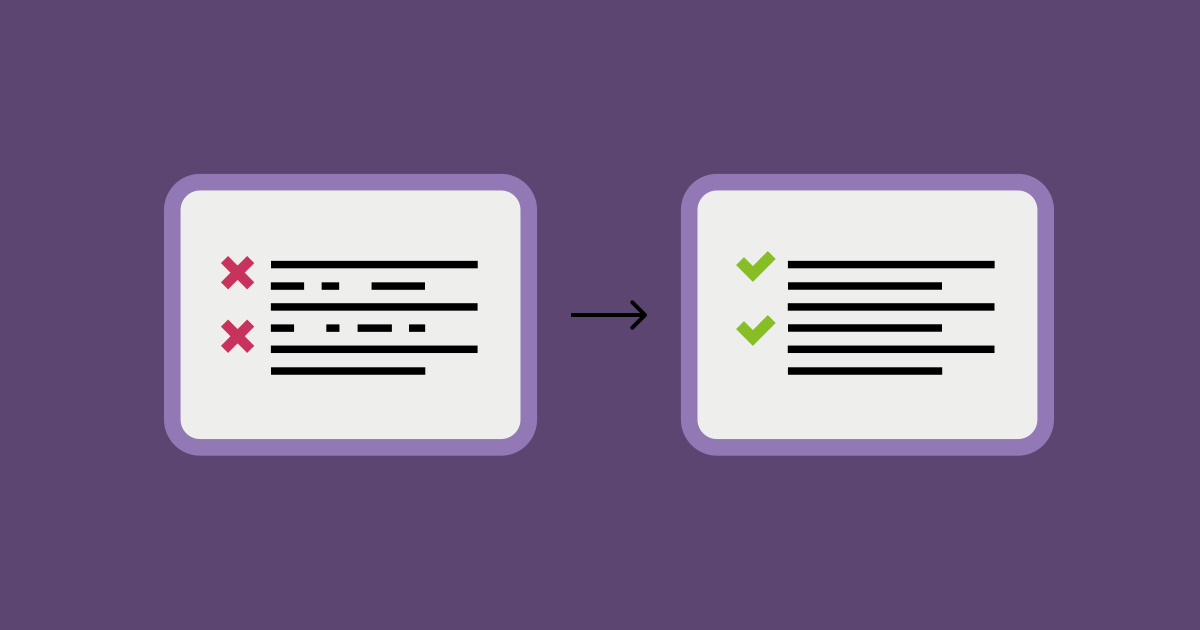
Many companies invest in automation only to wonder why the results fall short. Follow-up emails reach the wrong contact. Lead scores are based on outdated company information. Reports contain numbers nobody fully trusts.
The problem is rarely the workflow itself. More often, it's the data behind it.
Key takeaways:
- CRM data quality describes how complete, current, accurate, and consistent the data in your CRM is.
- Poor data quality has a direct business impact: 37 percent of CRM users have lost revenue because of unreliable data.
- Automation can prevent new errors caused by manual entry, but it can't automatically fix data that is already outdated or incorrect.
- Data quality naturally deteriorates over time because company and contact information constantly changes.
- To get lasting value from automation, data quality needs to be treated as an ongoing process rather than a one-time cleanup project.
What does CRM data quality actually mean?
Data quality may sound abstract, but it comes down to four straightforward questions:
Completeness: Are all relevant fields filled in? A contact without an email address, a company without an industry, or a deal without an assigned owner all represent gaps that someone will eventually have to fill manually.
Currency: Is the information still up to date? Companies relocate, employees change jobs, and businesses are acquired. B2B contact data can become outdated quickly, with some estimates putting annual data decay at 20 to 30 percent.
Accuracy: Is the information correct? Typos in company names, incorrect phone numbers, and duplicate records can all lead to mistakes further down the line.
Consistency: Is information recorded in the same way across the CRM? "GmbH" and "Gesellschaft mit beschränkter Haftung" mean the same thing, for example, but a CRM may treat them as two different values. Inconsistent data makes filtering, reporting, and automation less reliable.
What poor data quality actually costs.
The impact of poor CRM data can be significant.
According to Validity's State of CRM Data Management Report, 37 percent of CRM users have lost revenue because their data wasn't reliable, with an average of 16 sales opportunities lost per quarter. The report also found that 76 percent of companies say less than half of their CRM data is complete and accurate.
And the cost isn't limited to missed revenue.
Sales reps spend an estimated 546 hours a year — more than 13 full working weeks — chasing incorrect numbers, updating outdated records, and verifying information that should already have been reliable.
Why automation alone doesn't guarantee clean data.
Automating data capture is a major improvement. When contact information flows into the CRM automatically instead of being entered by hand, you can avoid many common errors: typos, missing fields, and inconsistent spellings.
But automation doesn't automatically fix the records that are already in your CRM.
A workflow built around an outdated job title, an old company address, or a duplicate contact will simply act on that bad data — automatically, quickly, and at scale.
That's the important distinction: automation can improve how new data enters your CRM, but it doesn't necessarily improve the data that's already there.
Data quality is an ongoing process.
One of the most common mistakes is treating data quality as a one-time cleanup project.
A team cleans up the CRM, everything looks good, and the problem seems solved. Six months later, the data has started to deteriorate again.
That's because data changes continuously. People change jobs. Companies grow, move, merge, or get acquired. Contact details become outdated.
Data quality therefore isn't something you fix once and forget about. It needs a process that keeps running.
That's the idea behind snapAddy DataAgents: instead of cleaning your CRM once, automated checks run continuously. A defined batch of contacts is reviewed, checked for current information, enriched, and corrected where necessary.
The result is a CRM that can stay up to date over time — because clean data isn't a one-time state. It's an ongoing process.
How snapAddy DataAgents turn CRM data quality into an ongoing process: