Trade Show Performance Measurement: Using KPIs to Evaluate Event Success
Improving Trade Show Results Through Professional Controlling.
Trade show controlling should begin well before the event itself. The goal is to determine which insights you want to gain for future decisions and how you plan to collect them. Careful planning and execution give you a clear picture of both the effort involved and the return generated by your trade show participation.
This requires defining a clear strategy and setting goals, both overall and for each individual participant, before the event starts. Only when goals are clearly defined can success be measured in a meaningful way.
Key questions to consider in advance include:
What objectives are you pursuing?
Which customers or target groups do you want to attract to your booth?
What expectations do visitors have?
Which tools or materials will help you reach and inform the largest number of visitors?
How should visitor surveys be designed?
What questions and content should the trade show questionnaire include?
During the trade show, you have the opportunity to survey visitors, track booth traffic, and collect contact details—particularly email addresses—for timely follow-up. This is also when the first performance checks can take place, such as comparing planned targets with actual results.
After the event, it’s advisable to conduct a visitor value analysis by comparing the actual visitor profile with your intended target group. A post-event target-versus-actual comparison can further clarify how well your objectives were met.
The following metrics are commonly used to assess trade show performance:
Number of booth visitors
New leads generated: A core objective of trade show participation is acquiring new customers and identifying new business opportunities.
Existing customer interactions
Visitor quality: How well do visitors match the defined target audience?
Average dwell time at the booth
Visitor surveys: These provide insights into why visitors stopped by, their satisfaction, the perceived quality of the booth, the markets they operate in, and their revenue potential.
Conversion rate: The percentage of booth visitors or leads that ultimately become customers.
Lead rejection rate: Based on predefined priority visitor groups, this metric captures contacts that are not usable (often referred to as “cold leads”).
Cost-related KPIs: Total costs including preparation and follow-up, booth space costs, daily trade show investment, cost per lead by category, and comparisons between trade show lead costs and field sales costs.
Year-over-year comparison
Trade show controlling is one of the most reliable ways to make success visible and to assess whether participating in a particular event was worthwhile.
Because trade show controlling can be resource-intensive (manual survey evaluation being a prime example) many companies look for tools that simplify the process.
Reducing Effort with Digital Lead Capture.
Digital solutions for trade show lead capture can help streamline data collection and analysis.
Tools such as snapAddy VisitReport allow teams to create customized questionnaires with a wide range of question types and conditional logic. Completed visit reports, including contact details captured via an integrated business card scanner, can then be exported directly into a CRM system.
Our Reporting 2.0 feature make it possible to analyze collected data in multiple ways, including:
Evaluation of individual survey questions
Number of completed reports per user
Overview of reports by hour
Results can be displayed in the reports using three different visual formats: pie chart, column chart, or bar chart, and viewed as either percentages or absolute figures.
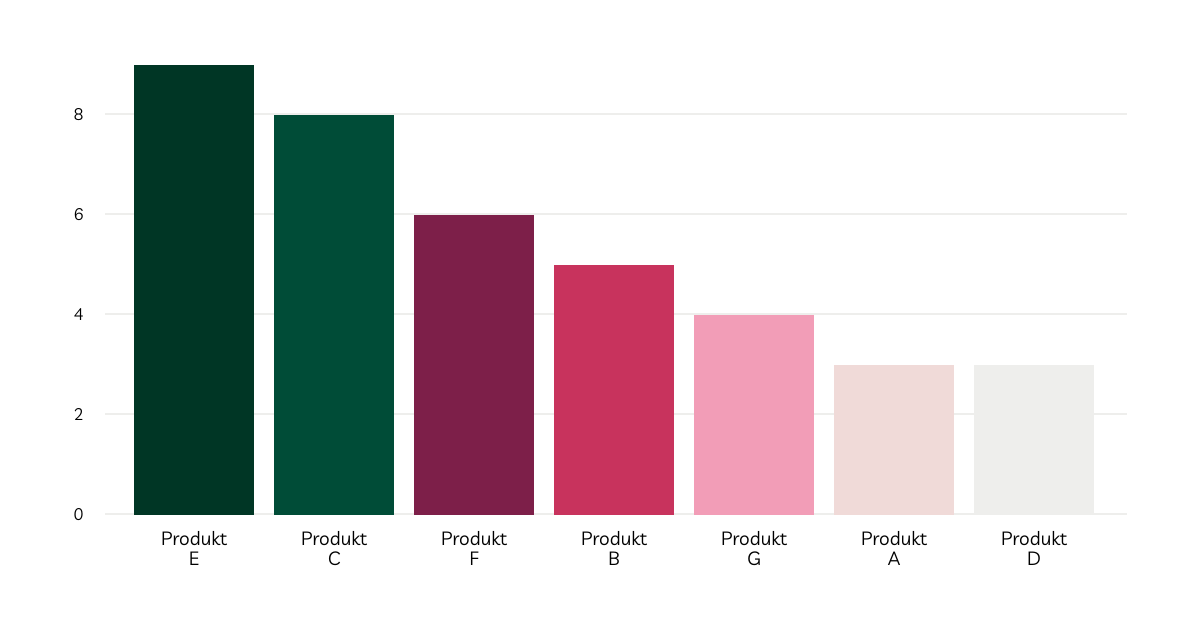
Turning Data Into Better Decisions.
With all data analyzed, visualized, and interpreted, you gain a reliable foundation for evaluating your trade show KPIs. When these insights are used thoughtfully, they can help make future trade show appearances more targeted, efficient, and ultimately more successful.