What is an API? Explained for Sales and Ops without a computer science degree.
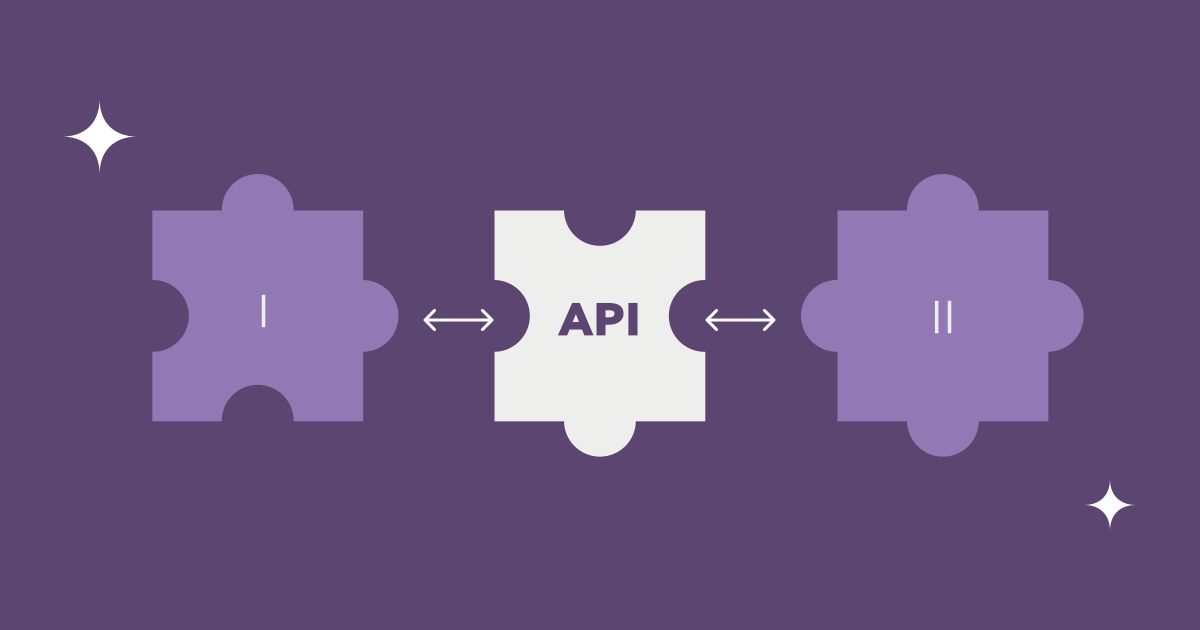
API is one of those terms that pops up in almost every conversation about software integration and is almost never explained. The assumption is that everyone knows what it means.
The essentials at a glance:
- API stands for Application Programming Interface: an interface that allows two software systems to communicate with each other.
- APIs are the foundation of any modern integration: they enable your CRM system, email tool, data provider, and automation platform to work together as one system.
- For Sales and Ops, understanding APIs is not optional: if you build or evaluate workflows, you need to know what an API can and cannot do.
- APIs are not unlimited: rate limits, authentication, and versioning define what is feasible.
- MCP (Model Context Protocol) is the next step: an open protocol developed specifically for AI agents.
What an API is and what it does.
An API is a defined interface that allows one software system to communicate with another. It specifies: What requests can I make? What do I get back? In what format?
The simplest analogy: a restaurant. The kitchen is the system that does the work. The menu is the API; it defines what you can order, how you order it, and what you will get. As a guest, you do not need to know how the kitchen works. You only need to know what is on the menu.
In the software world this means: a CRM system has an API that allows other programs to retrieve, create, or update contacts. A data provider has an API that lets you request company data. An automation tool like n8n or snapAddy DataAgents uses these APIs to move data between systems without anyone having to copy and paste manually.
Why APIs matter for Sales and Ops.
Anyone who builds, buys, or evaluates workflows inevitably runs into the question: Does this tool have an API? And what can that API actually do?
The answer defines what is possible. A CRM system without an open API cannot easily be connected to external data enrichment services. A tool without API documentation is hard to integrate. The API quality of a system often matters more than its user interface because it determines how well it fits into an existing tech stack.
In day-to-day operations this means: when snapAddy DataAgents enriches contacts in the CRM system, that all runs over APIs. DataAgents calls the CRM API, retrieves records, queries external data providers via their APIs, and writes results back through the CRM API. The user sees the outcome in the CRM system, while the API communication runs invisibly in the background.
Where APIs hit their limits.
APIs are not unlimited. Three constraints are particularly relevant in practice:
Rate limits: Most APIs restrict how many requests can be made per minute or per hour. A workflow that tries to enrich 10,000 contacts at once can hit this limit. Well-designed automation solutions therefore distribute the load over time, for example with daily batches instead of a single mass request.
Authentication: APIs are not publicly accessible. Access is granted via API keys or other authentication methods. This is not just a technical detail; it is a security issue: anyone who has access to an API key can act on behalf of the system.
Versioning: APIs change. Providers release new versions and eventually retire old ones. A workflow that is based on an outdated API version may stop working after a provider update. This is a common but often underestimated reason for maintenance work.
From API to MCP: What changes for AI systems.
Classic APIs are built for rule-based systems and human developers. They are precise but rigid: every connection has to be built, documented, and maintained individually.
MCP (Model Context Protocol) is an open protocol released by Anthropic in 2024, developed specifically for AI agents. The core idea: instead of every AI agent needing its own custom integration for each tool, there is a unified standard. An agent that supports MCP can connect to any MCP-compatible tool without bespoke integration work.
For Sales and Ops teams this is becoming increasingly relevant. If you want to use AI agents that access CRM data, read calendars, or send messages, you benefit when these systems support MCP. Setup becomes easier, maintenance more manageable, and you can connect new tools faster.
MCP is still young, but the direction is clear: while APIs are the language of classic software integration, MCP is becoming the language of AI-driven automation.
What no API access means.
Some systems, especially older software or highly specialized industry solutions, offer no APIs or only very limited ones. This is not a niche problem. It means: no automatic integration, no data exchange without manual export, no workflow without detours.
This is where RPA comes in: bots that imitate user interfaces because no API is available. This can work, but it is fragile and maintenance-intensive. A clean API integration is always the better solution where one is possible.
Learn more about snapAddy DataAgents and how the workflow automation platform uses CRM APIs to enrich data and keep it up to date. In our node library, you can see which systems can be connected via an API.