"No One Enjoys Typing Contact Information by Hand." Jochen on Ten Years of snapAddy.
Ahead of the NIMA Marketing Days 2026 in Utrecht, Jochen sat down with MarketingTribune to look back on ten years of snapAddy, from the founding idea to the future of B2B lead generation. The original interview appeared in Dutch under the title "Contactdata als fundament voor betere B2B-sales." We've summarized and edited the key takeaways for this piece.
Ten years ago, Jochen, Roland, and Sebastian founded snapAddy out of a simple frustration: no one wants to type contact information by hand. Today, the company helps 4,000 customers across multiple countries automatically turn unstructured addresses, business cards, email signatures, and trade show contacts into clean CRM data. Looking back, Jochen talks about where the company started, the most expensive mistakes in day-to-day sales work, and where lead generation is heading in the years ahead.
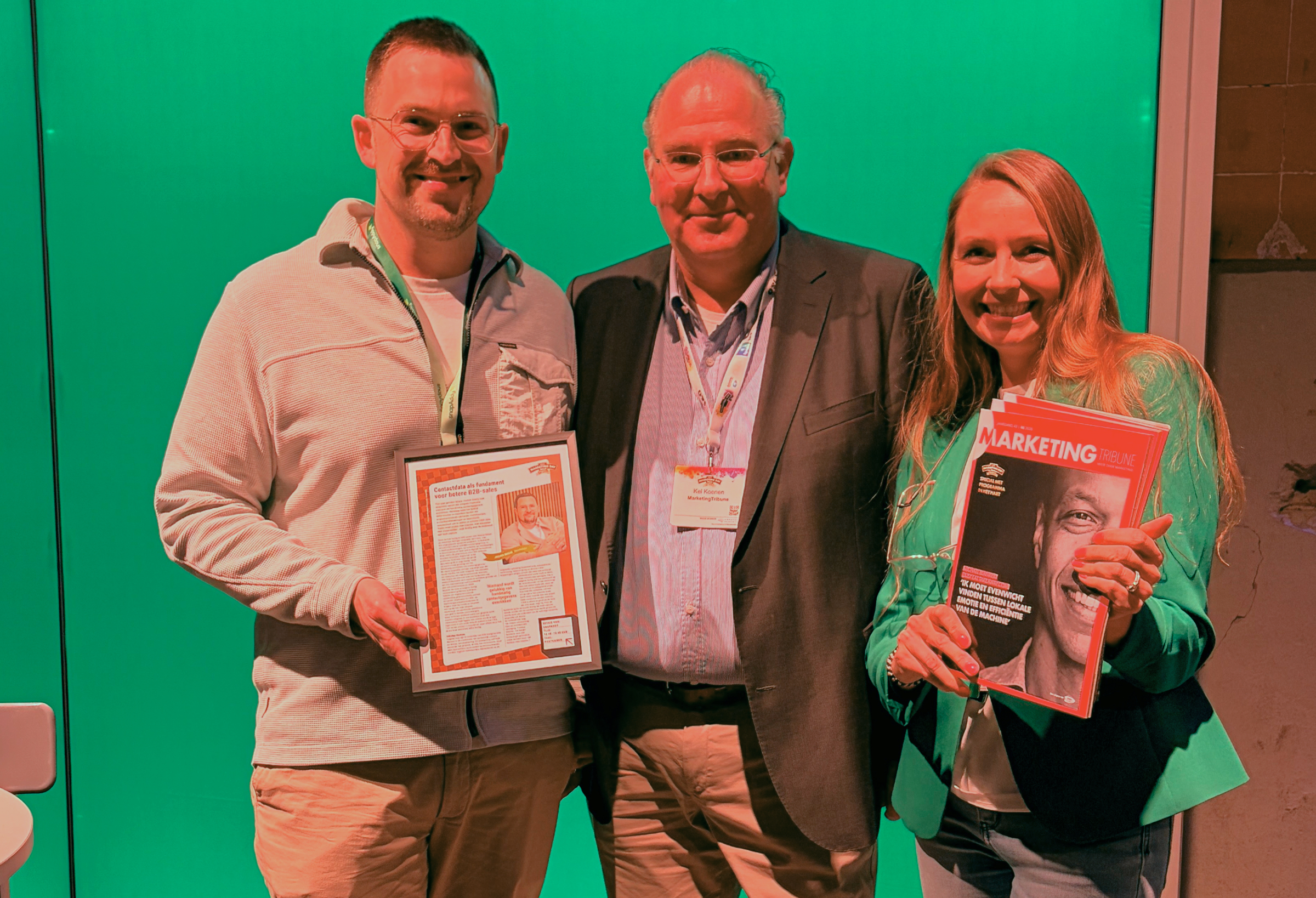
L–R: Jochen Seelig (snapAddy), Kel Koenen (Editor-in-Chief, MarketingTribune) and Elke Averbeck (snapAddy) at NIMA Marketing Day 2026 in Utrecht.
A company name that says it all.
The starting point in 2015 was almost embarrassingly simple. Business contact information was circulating everywhere across companies: in email signatures, on websites, on business cards, in trade show materials. The moment that data was supposed to make it into the CRM system, the real problems started. "Everyone knows good data matters," Jochen says, "but no one enjoys typing contact information by hand."
The name snapAddy still points to that founding promise: extracting addresses and contacts quickly from unstructured sources. What began as a tool for recognizing contact information in emails and on websites grew into an international software company. Today snapAddy has 120 employees and 4,000 customers across multiple countries.
According to Jochen, the core is unchanged: helping companies move unstructured contact information into CRM and marketing automation systems in a structured, correct, and duplicate-free way. Ten years of development haven't changed that. What has changed is how that data comes into existence in the first place.
Where leads get lost at trade shows.
At events and trade shows in particular, Jochen sees the same mistakes over and over. Marketing and sales teams invest a lot of money in face-to-face meetings, then lose momentum the moment a conversation has to be turned into a usable lead. A business card gets forgotten. A note is captured too late. A name ends up in the CRM twice.
"The first touch is valuable, but only if you can act on it right away," the CEO says. That moment between conversation and system entry is exactly where a trade show contact either becomes real business, or it doesn't.
Personal contact stays; the rest has to move faster.
For Jochen, the future of B2B lead generation lies in the combination of personal contact and intelligent automation. The conversation, the connection, the trust: that stays. Everything around it has to get faster and more reliable.
Digital business cards via BusinessCards, intelligent workflow via DataAgents, data enrichment, and direct CRM integrations mean sales no longer has to handle the administrative aftermath. Instead, they can follow up right away, while the contact is still fresh.
Quality beats quantity.
For Jochen, this is also a response to the changing role of marketing. It's not the number of leads that matters, but their quality and usability. A complete, correct, and quickly captured lead is worth more than a pile of unstructured contacts with no context.
"CRM is only as good as the data it holds," the CEO says. A sentence that sounds simple, and yet most CRM problems trace back to exactly that.
Lead generation as part of the customer journey.
Jochen expects lead generation to be seen less as an isolated process in the coming years and more as part of the entire customer journey. snapAddy wants to be the interface between meetings, data, and commercial follow-up.
"Communicating smarter, not harder, means using technology so people have more time for relationships," Jochen says. Ten years in, that's still the summary of what snapAddy is trying to solve.
If you want to see how automated workflows actually fit into day-to-day sales work, here's an overview of DataAgents.