NFC Business Cards: The Bridge between Tradition and Digitization.

Near Field Communication (NFC) is a technology that has significantly expanded how objects can exchange small amounts of data. It enables wireless communication over short distances, building on RFID (radio-frequency identification) technologies. NFC first became widespread through contactless payments, for example when paying a bill via smartphone.
Exchanging Contact Information via NFC.
In the meantime, many additional use cases have emerged, which brings us to our topic: NFC business cards. With an NFC business card, the information stored on the NFC chip—such as contact information and links to online profiles—is retrieved simply by holding it near a compatible smartphone. The data volumes involved are relatively small, as they consist essentially of plain text.
It makes no difference whether you use an NFC business card for iPhone or an NFC business card for Android: modern smartphones on both platforms support the technology without any issues.
This seamless exchange process merges physical and digital networking into a single step. The development of the NFC business card therefore represents a significant advancement in personal and professional networking. Its growing popularity is likely also a reflection of the increasing demand for digital, efficient, and environmentally friendly solutions across all areas of business life.
A Comparison: Traditional, Digital, and NFC Business Cards.
Even though semi-digital NFC cards and fully digital business cards are gaining ground, printed versions are still the most widely used. But how exactly do they differ? What are the pros and cons?
Traditional business cards remain popular because they are simple and universally accepted. In some cultures, their design and the ceremonial act of handing them over carry real significance. Their main drawback is their static nature: once printed, information cannot be updated without producing new cards. That leads to unnecessary costs, inefficient processes, and resource consumption that many companies can no longer afford – or justify – in times of ISO-certified environmental management and sustainability criteria for suppliers.
Digital business cards (apps) represent the current peak of digital networking and offer full flexibility for keeping data up to date. HR no longer has to ask a service provider or marketing to prepare print templates, procurement does not have to intervene, and no paper bin needs to be filled with outdated printed cards. Professional digital business cards keep themselves up to date by connecting to an Active Directory or HR management system. In theory, every person in the company could even maintain their own digital business card. Whether business contacts in every culture worldwide are truly enthusiastic about scanning a QR code is another question. Nonetheless, the underlying digitalization of the business world is progressing globally and across cultural boundaries.
How long the special status of the printed business card will actually last therefore remains an open question.
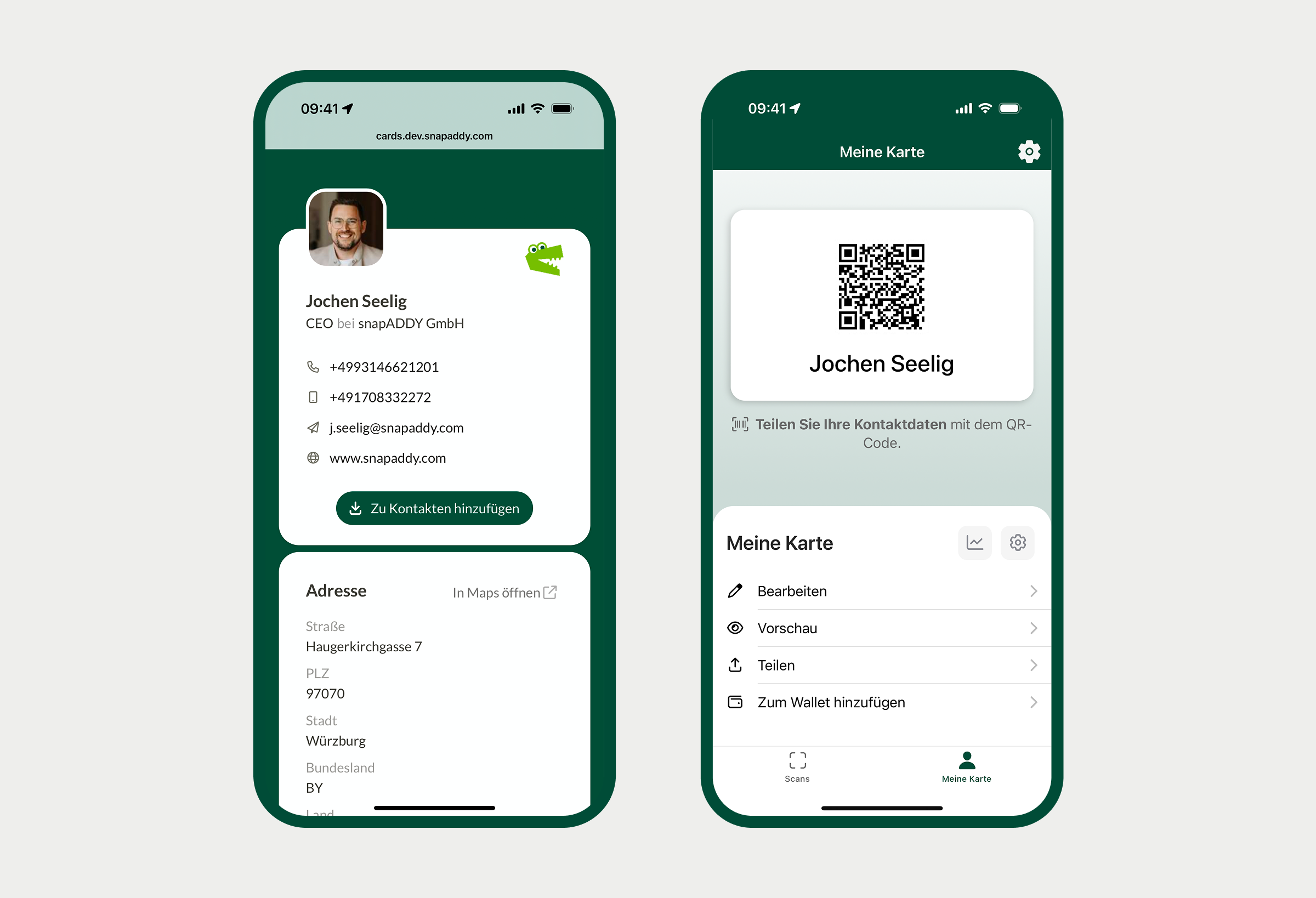
- NFC business cards offer a dynamic solution. An NFC business card is not only a physical medium of exchange; it also allows you to update the stored information promptly. Various apps for iOS and Android enable virtually anyone to keep an NFC business card up to date using a smartphone – whether it is an NFC business card for iPhone or Android devices. NFC cards are a compromise between both worlds. They do combine the advantages of the other two variants, but they are not a complete substitute in any respect and can also be disadvantageous in some situations. For example, while you can ceremonially present an NFC business card to an Asian business partner, you would then actually have to take it back again, which would be quite an affront. So why not simply leave the card with the customer? Because that would negate the sustainability advantage compared to a printed card. It would be interesting to calculate how often an NFC business card would have to be used before it becomes more sustainable than a one-off paper card.
NFC Business Cards: Production, use, and handling.
Production and ordering: NFC business cards combine traditional printing processes with embedded NFC tags. Online platforms offer extensive customization options, from visual design to the selection of stored information.
Usage: Using an NFC business card is straightforward. Holding it close to an NFC-enabled device transfers the stored information. The device sends a small power impulse to activate the chip. This widely adopted technology works with a broad range of smartphones and tablets. Initial programming can be done using dedicated devices—or, in most cases, directly via a smartphone.
Handling: Despite the advanced technology, NFC business cards are almost as easy to handle as traditional ones. The main consideration is protecting the embedded NFC chip from extreme conditions to ensure long-term functionality.
NFC Business Cards as a Practical Intermediate Step.
NFC business cards combine the physical handover with digital data exchange: contact information can be shared quickly without giving up the face-to-face ritual of handing over a traditional business card.
They provide particular value at trade fairs and events.
The case for NFC business cards:
Fast exchange: contact information can be transferred instantly
Always up to date: information can be updated at any time
Lower paper consumption: reduces the resources used for traditional business cards
Personal, in‑person exchange of contact details is preserved.
This makes NFC business cards a useful intermediate step. They ease the transition from physical to digital business card – especially in contexts where a personal handover is still expected.
Bringing both worlds together with snapAddy – from NFC business card to fully digital solution.
snapAddy supports you throughout your entire journey toward digitalizing your contact information – from the optimal NFC business card to a fully digital business card. If you prefer to make the switch from physical to digital business cards step by step, snapAddy is a good fit: high-quality NFC business cards combine the familiarity of a physical card with the benefits of the digital world. You retain the personal character of the handover, while your contact information remains up to date and can be accessed instantly via smartphone.
If you want to skip the NFC interim step, you can move straight to snapAddy BusinessCards: free of charge, individualized to your corporate design and, if required, with company-wide administration features.
Wherever you currently are on the path between physical and digital business card, snapAddy is there at every step. Start for free now or arrange an appointment.